
Starting the Engine

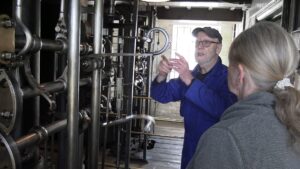
To start the engine, the driver eases open the steam throttle valve until the in-house side of the beam begins to descend.
The driver cannot see the beam, and instead relies upon observation of movement of the plug rod. When the beam has completed about half of its travel, with the left hand, the driver grasps the equilibrium valve lever to prevent it from dropping, then with the right hand, he depresses the exhaust valve lever. This releases the equilibrium valve lever, which without the driver’s intervention, would open the equilibrium valve fully and allow the in-house side of the beam to return to the up position without constraint. As at this early stage of the start the water pump is not primed so there is nothing to cushion this return stroke. If the equilibrium valve was fully opened, the engine would overstroke. The driver prevents this by his control of the equilibrium valve lever, which he eases downwards sufficiently to allow a controlled return stroke. Once the beam has returned nearly to the top of its stroke, the driver lifts the equilibrium lever allowing the valve to open which trips the inlet valve and the power stroke starts again.
The driver repeats the above cycle of controlled action until the water pump is primed (i.e. delivering water). He can tell this has occurred by observation of the return stroke, but it is also normal at Crofton to have an assistant watching the launders to confirm that there is ‘water up’ (the pump is delivering water). Once the rising mains are filled and ‘water up’ the driver can safely allow the equilibrium lever to fall without manual constraint. Throughout this part of the start, the driver is also monitoring development of the vacuum, which he does by watching the vacuum gauge on the wall behind. The Driver can also gauge the vacuum by the response of the engine during the power stroke. Once ‘water up’ and the condenser vacuum fully developed, the driver can begin progressively opening the steam throttle to increase the stroke, until it becomes sufficient for the valves to trip themselves without intervention. The start cycle is then complete, and it remains the driver’s job to monitor the stroke of the beam and adjust the steam throttle so as to keep the stroke within acceptable limits, allowing for variations of steam pressure.

Stopping the Engine
At a point in the cycle where the equilibrium valve is full up (steam piston at the top of its stroke), the driver grasps the equilibrium valve lever and holds it there. The engine completes the power stroke and then stops with the in-house side of the beam down. The driver then closes the steam throttle, holds the exhaust valve lever down and eases the equilibrium valve down to allow the in-house side of the beam to slowly rise until the pump side is resting upon the stops.